Executive journal
Why AI is Killing the "Brilliant Jerk": A Decisive Guide to Relationship Architecture — The Decisive Leader
When I was coming up in the Army, there was always that one guy. You know the one—a total jerk, zero people skills, but he was "damn good at his job." In the old world, we tolerated the friction because we needed the…
Why AI is Killing the "Brilliant Jerk" (And Why Your Soft Skills are the New Armor)
When I was coming up in the Army, there was always that one guy. You know the one—a total jerk, zero people skills, but he was "damn good at his job." In the old world, we tolerated the friction because we needed the technical output. We traded culture for competence.
Those days are over. In a world where AI can handle the "Hard Skills"—the data, the coding, the Predictive Delivery—being "good at your job" is now the baseline. If your only value is technical output and you’re a liability to the team's culture, you are officially replaceable. AI is faster, cheaper, and it doesn’t have an ego. People don't want to work with jerks, and now, they don't have to.
The "Brilliant Jerk" is a relic of a world where technical output was the only metric that mattered. But their resistance to change—their refusal to evolve their "interface"—isn't actually about being mean. It's a psychological trap. Change is tough.
For example, my daughters will flat-out refuse to watch a new movie. They don’t want the unknown; they want the safety of the reruns they’ve seen fifty times. In my book, The Decisive Edge, I call this Narrow Framing. Whether you’re an Army LTC, a C-Suite executive, or a seven-year-old, the brain naturally tries to protect you from the discomfort of the new.
But in business, Change Management isn't a suggestion; it's a survival requirement. If you can’t widen the frame, you’ll find yourself just like that jerk from my Army days: technically capable, but strategically obsolete. Most leaders are doing the exact same thing with AI and culture shifts. They are stuck in Narrow Framing, looking at the change through a tiny lens of fear. They are comfortable with their "Brilliant Jerks" and their old spreadsheets. But comfort is the enemy of growth.
But let's be real: widening the frame is exhausting. It’s a lot easier to stay in the reruns.
If you’re a runner, you know about Threshold Runs. These aren't easy jogs. They are sustained efforts at the very limit of your aerobic capacity. You are intentionally putting your body in a state where it is screaming to stop, specifically to train your system to handle the lactic acid and the mental fatigue. You do it because it’s the only way to get faster, stronger, and better.
Change Management is the corporate version of a threshold run. It’s meant to be uncomfortable. If you are implementing a change and it feels "easy," you aren't actually changing. You have to seek Comfort with being Uncomfortable. You have to train your organizational "lungs" to breathe in the thin air of the unknown.
In my book, The Decisive Edge, I talk about how most people quit right at the threshold. They mistake the "burn" of growth for a signal to stop. But as a leader, your job is to pace the team through that burn until the uncomfortable becomes the new baseline. If you want to get stronger, you don't lift light weights that feel "easy." If you aren't feeling the strain of evolving your interpersonal skills, you’re drifting. To bridge the Strategy-to-Execution Gap, you have to be comfortable being uncomfortable.
The Soft Skill Offensive
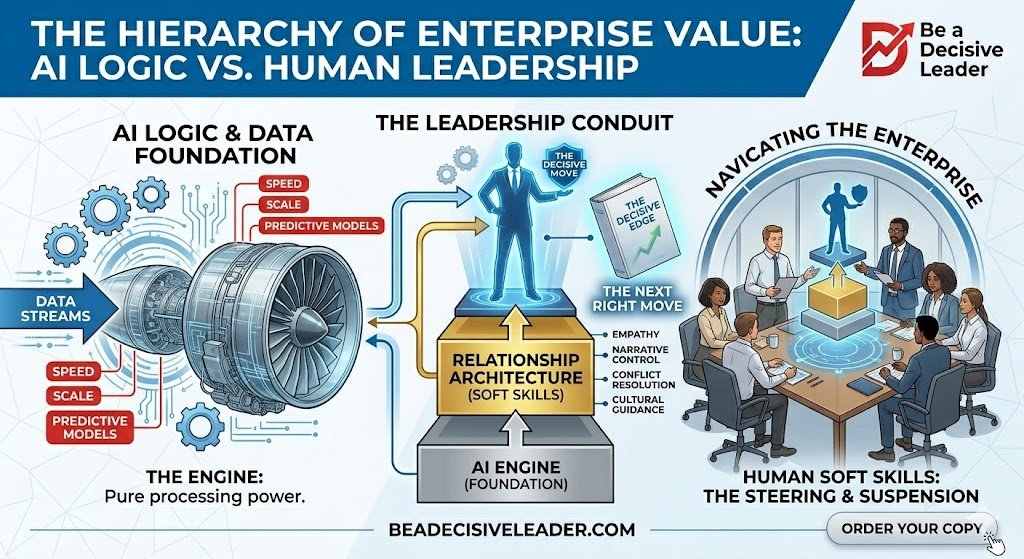
As a leader, your differentiator is no longer what you know—it’s how you lead. I call this improving your Relationship Architecture. While AI runs the engine, you must provide the steering and suspension through these essential human skills:
- Tactical Empathy: AI can analyze sentiment, but it can’t feel it. It can’t sit across from a burnt-out engineer and understand the "why" behind the bottleneck. Humans build Trust*; machines build data points*.
- Narrative Control: AI can generate a report, but it can’t tell a story that inspires a team to charge a hill. Leaders translate "what happened" into "why it matters."
- Conflict Resolution & Nuance: AI follows a script. It cannot read the unspoken political friction in a boardroom or de-escalate a heated cross-functional standoff. Leaders sense the tension and leaders casually navigate this friction into an opportunity.
- Tactical Calm: In a crisis, AI provides facts. A leader provides certainty. You cannot automate the steady hand that prevents a team from spiraling into Emotional Noise.
Here’s the so what. If you’ve been relying on being the "technical expert" while neglecting your soft skills, you’re standing on a melting ice cube. The "Brilliant Jerk" is a legacy system waiting to be decommissioned.
It’s time to widen the frame. Learn how to use your Decisive Edge to stop drifting and start mastering the human side of execution. Don't be the relic who got left behind because they were too proud to improve.
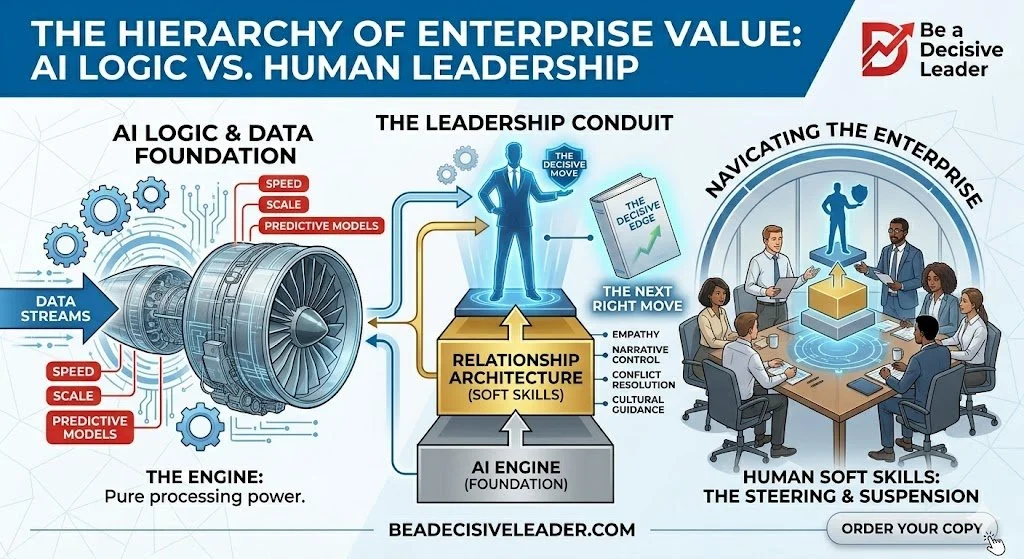
The Decisive Leader Framework: Why AI is the engine, but Relationship Architecture is the steering and suspension of a successful enterprise.